Fill Out Your Irs 656 Form
The IRS Form 656 is a crucial document for taxpayers seeking to settle their tax debts for less than what they owe through an Offer in Compromise (OIC). This form initiates the process where the IRS evaluates an individual's financial ability to pay. A successful OIC results in a settlement that benefits both the taxpayer and the IRS. To determine eligibility, applicants must meet specific criteria, including having filed all necessary tax returns and making required tax payments. The form outlines essential steps, guiding users through calculating an appropriate offer based on assets, income, and expenses. It also details the required application fee, payment options, and vital responsibilities to maintain eligibility during the evaluation period. Additional resources, such as the OIC Pre-Qualifier tool, assist taxpayers in assessing their situation before submission. For those unsure of their tax status, the IRS provides contact information for further assistance. Understanding these aspects is essential for anyone considering an Offer in Compromise, as the process can directly impact their financial future.
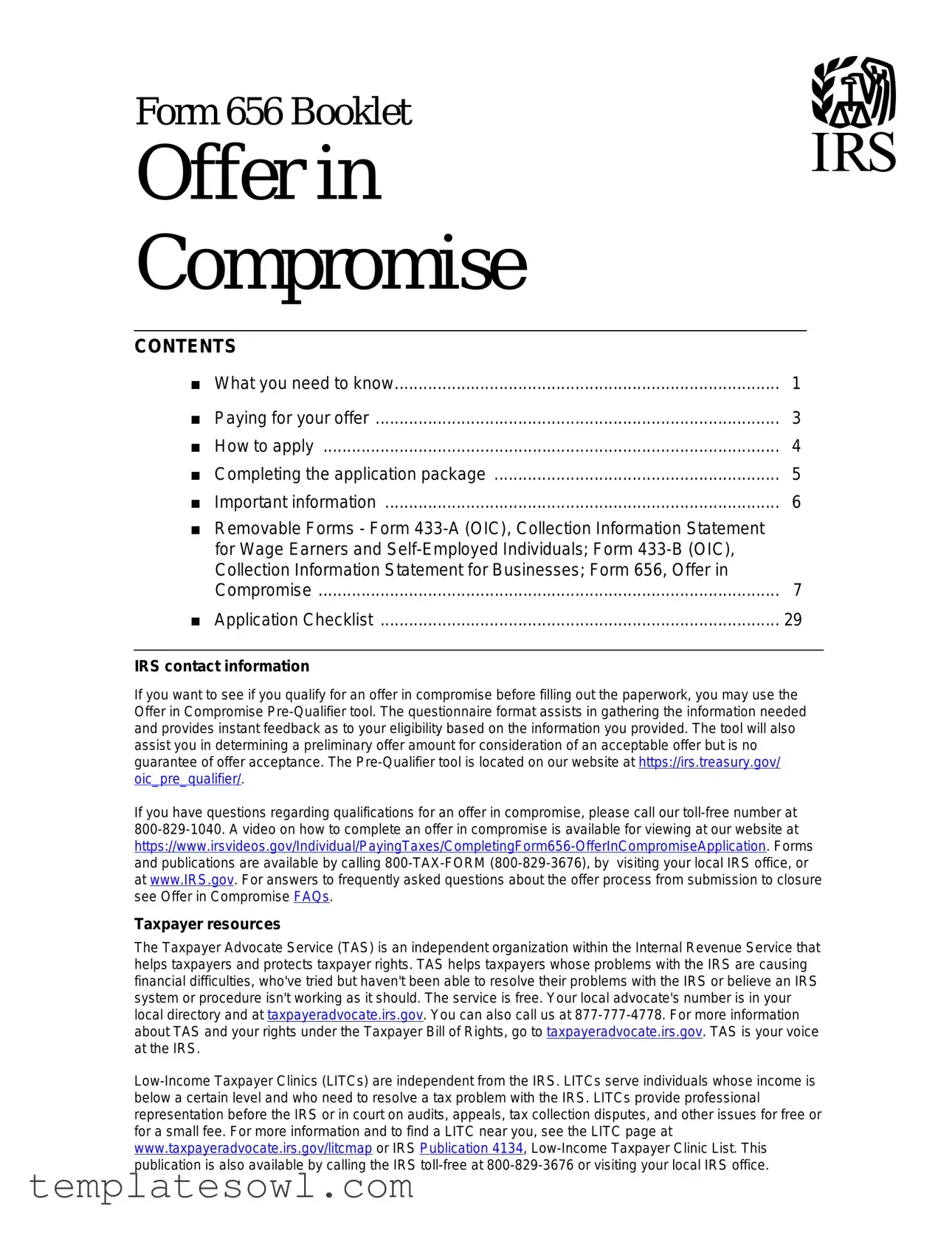
Irs 656 Example

Form 656 Booklet |
|
Offer in |
|
Compromise |
|
CONTENTS |
|
■ What you need to know |
1 |
■ Paying for your offer |
3 |
■ How to apply |
4 |
■ Completing the application package |
5 |
■ Important information |
6 |
■Removable Forms - Form
Collection Information Statement for Businesses; Form 656, Offer in |
|
Compromise |
7 |
■ Application Checklist |
29 |
IRS contact information
If you want to see if you qualify for an offer in compromise before filling out the paperwork, you may use the Offer in Compromise
If you have questions regarding qualifications for an offer in compromise, please call our
Taxpayer resources
The Taxpayer Advocate Service (TAS) is an independent organization within the Internal Revenue Service that helps taxpayers and protects taxpayer rights. TAS helps taxpayers whose problems with the IRS are causing financial difficulties, who've tried but haven't been able to resolve their problems with the IRS or believe an IRS system or procedure isn't working as it should. The service is free. Your local advocate's number is in your local directory and at taxpayeradvocate.irs.gov. You can also call us at

WHAT YOU NEED TO KNOW
What is an Offer? |
An Offer in Compromise (offer) is an agreement between you (the taxpayer) and |
|
|
the IRS that settles a tax debt for less than the full amount owed. The offer |
|
|
program provides eligible taxpayers with a path toward paying off their tax debt. |
|
|
The ultimate goal is a compromise that suits the best interest of both the taxpayer |
|
|
and the IRS. Generally, you must |
make an appropriate offer based on what the |
|
IRS considers your true ability to |
pay. |
|
Submitting an application does not ensure that the IRS will accept your offer. |
|
|
It begins a process of evaluation and verification by the IRS, taking into |
|
|
consideration any special circumstances that may affect your ability to pay. |
|
|
This booklet will lead you through a series of steps to help you calculate an |
|
|
appropriate offer based on your assets, income, expenses, and future earning |
|
|
potential. The application requires you to describe your financial situation in detail, |
|
|
so before you begin, make sure you have the necessary information and |
|
|
documentation. |
|
Are You Eligible? |
Before your offer can be considered, you must (1) file all tax returns you are legally |
|
|
required to file, (2) have received a bill for at least one tax debt included on your |
|
|
offer, (3) make all required estimated tax payments for the current year, and (4) |
|
|
make all required federal tax deposits for the current quarter if you are a business |
|
|
owner with employees. The IRS will immediately return your offer without further |
|
|
consideration if you have not filed all legally required tax returns. |
|
|
Note: If it is determined you have not filed all tax returns you are legally |
|
|
required to file, the IRS will apply any initial payment you sent with your offer |
|
|
to your tax debt and return both your offer and application fee to you. You |
|
|
cannot appeal this decision. |
|
Bankruptcy, Open Audit or |
If you or your business is currently in an open bankruptcy proceeding, you are not |
|
Innocent Spouse Claim |
eligible to apply for an offer. Any resolution of your outstanding tax debts generally |
|
|
must take place within the context of your bankruptcy proceeding. |
|
|
If you are not sure of your bankruptcy status, contact the Centralized Insolvency |
|
|
Operation at |
|
|
and/or Taxpayer Identification Number. |
|
|
Resolve any open audit or outstanding innocent spouse claim issues before |
|
|
you submit an offer. |
|
Can You Pay in Full? |
Generally, the IRS will not accept an offer if you can pay your tax debt in full |
|
|
through an installment agreement or equity in assets. |
|
|
Note: Adjustments or exclusions, which may be considered during the offer |
|
|
investigation, such as allowance of $1,000 to a bank balance or $3,450 against the |
|
|
value of a car, are only applied if you are an individual and after it is determined |
|
|
that you cannot pay your tax debt in full. |
|
Your Future Tax Refunds |
The IRS will keep any refund, including interest, for tax periods extending through |
|
|
the calendar year that the IRS accepts the offer. For example, the IRS accepts |
|
|
your offer in 2020 and you file your 2020 Form 1040 on April 15, 2021 showing a |
|
|
refund; the IRS will apply your refund to your tax debt. The refund is not |
|
|
considered as a payment toward your offer. |
|
Doubt as to Liability |
If you have a legitimate doubt that you owe part or all of the tax debt, complete and |
|
|
submit a Form |
|
|
Form |
|
|
FORM |
|
Note: Do not submit both an offer under Doubt as to Liability and an offer under Doubt as to Collectibility or Effective Tax Administration at the same time. You must resolve any doubt you owe part or all of the tax debt before submitting an offer based on your ability to pay.
1
Notice of Federal Tax Lien |
A lien is a legal claim against all your current and future property. When you don’t |
|
pay your first bill for taxes due, a lien is created by law and attaches to your |
|
property. A Notice of Federal Tax Lien (NFTL) provides public notice to creditors. |
|
The IRS files the NFTL to establish priority of the IRS claim versus the claims of |
|
certain other creditors. The IRS may file a NFTL at any time. If the tax lien(s) has/ |
|
have not been released, the IRS may be entitled to any proceeds from the sale of |
|
property subject to the lien(s). You may be entitled to file an appeal under the |
|
Collection Appeals Program (CAP) before this occurs or request a Collection Due |
|
Process hearing after this occurs. |
|
Note: A Notice of Federal Tax Lien (NFTL) will not be filed on any individual shared |
|
responsibility payment under the Affordable Care Act. |
Trust Fund Taxes |
If your business owes liabilities that include trust fund taxes, the IRS may hold |
|
responsible individuals liable for the trust fund portion of the tax pursuant to |
|
applicable law. Trust fund taxes are the money withheld from an employee's |
|
wages, such as income tax, Social Security, and Medicare taxes. If the IRS enters |
|
into a compromise with an employer for a portion of the trust fund tax liability, the |
|
remainder of the trust fund taxes must be collected from the responsible parties. |
|
You are not eligible for consideration of an offer unless the trust fund portion of the |
|
tax is paid, or the IRS has made the Trust Fund Recovery Penalty determination(s) |
|
on all potentially responsible individual(s). However, if you are submitting the offer |
|
as a victim of payroll service provider fraud or failure, the trust fund recovery |
|
penalty assessment discussed above is not required prior to submitting the offer. |
Other Important Facts |
Each and every taxpayer has a set of fundamental rights they should be aware of |
|
when interacting with the IRS. Explore your rights and our obligations to protect |
|
them. For more information on your rights as a taxpayer, go to http://www.irs.gov/ |
|
|
|
Penalties and interest will continue to accrue. |
|
After you submit your offer, you must continue to timely file and pay all required tax |
|
returns, estimated tax payments, and federal tax payments for yourself and any |
|
business in which you have an interest. Failure to meet your filing and payment |
|
responsibilities during consideration of your offer will result in the IRS returning |
|
your offer. If the IRS accepts your offer, you must continue to stay current with all |
|
tax filing and payment obligations through the fifth year after your offer is accepted |
|
(including any extensions). |
|
Note: If you have filed your tax returns but you have not received a bill for at |
|
least one tax debt included on your offer, your offer and application fee may |
|
be returned and any initial payment sent with your offer will be applied to |
|
your tax debt. To prevent the return of your offer, include a complete copy of |
|
any tax return filed within 12 weeks of this offer submission. |
|
The IRS can't process your offer if the IRS referred your case, or cases, involving |
|
all of the liabilities identified in the offer to the Department of Justice. In addition, |
|
the IRS cannot compromise any tax liability arising from a restitution amount |
|
ordered by a court or a tax debt reduced to judgment. Furthermore, the IRS will not |
|
compromise any IRC § 965 tax liability for which an election was made under IRC |
|
§ 965(i). You cannot appeal this decision. |
|
Note: Any offer containing a liability for which payment is being deferred under IRC |
|
§ 965(h)(1) can only be processed for investigation if an acceleration of payment |
|
under section 965(h)(3) and the regulations thereunder has occurred and no |
|
portion of the liability to be compromised resulted from entering into a transfer |
|
agreement under section 965(h)(3). |
|
The law requires the IRS to make certain information from accepted offers |
|
available for public inspection and review. Find instructions to request a public |
|
inspection file at www.IRS.gov keyword "OIC". |
2
|
The IRS may levy your assets up to the time the IRS official signs and |
|
acknowledges your offer as pending. In addition, the IRS may keep any proceeds |
|
received from the levy. If your assets are levied after your offer is submitted and |
|
pending evaluation, immediately contact the IRS employee whose name and |
|
phone number are listed on the levy. |
|
If you currently have an approved installment agreement, you will not be required |
|
to make your installment agreement payments while your offer is being |
|
considered. If your offer is not accepted and you have not incurred any additional |
|
tax debt, the IRS will reinstate your installment agreement. |
|
|
PAYING FOR YOUR OFFER |
|
Application Fee |
Offers require a $205 application fee. |
|
Exception: If you are an individual and meet the |
|
guidelines, there is no requirement to send any money with your offer. You |
|
are considered an individual if you are seeking compromise of a liability for which |
|
you are personally responsible, including any liability you incurred as a sole |
|
proprietor. |
Payment Options |
You must select a payment option and include the initial payment with your offer. |
|
The amount of the initial payment and subsequent payments will depend on the |
|
total amount of your offer and which of the following payment options you choose: |
|
Lump Sum Cash: This option requires 20% of the total offer amount to be paid |
|
with the offer and the remaining balance paid in 5 or fewer payments within 5 or |
|
fewer months of the date your offer is accepted. |
|
Periodic Payment: This option requires you to make the first payment with the |
|
offer and the remaining balance paid in monthly payments within 6 to 24 months, |
|
in accordance with your proposed offer terms. |
|
Note: Under the periodic payment option, you must continue to make |
|
monthly payments while the IRS is evaluating your offer. If you fail to make |
|
these payments at any time prior to receiving a final decision letter, the IRS will |
|
return your offer. You cannot appeal this decision. Total payments must equal the |
|
total offer amount. |
|
Reminder: The initial payment and monthly payments are not required if you meet |
|
the |
|
Generally, payments made on an offer will not be returned. You may make a |
|
deposit, as described in Form 656, Section 5, which may be returned if the offer is |
|
not accepted. If the IRS accepts your offer, your payments made during the offer |
|
process, including any money designated as a deposit, will be applied to your offer |
|
amount. |
|
If you do not have sufficient cash to pay for your offer, you may need to consider |
|
borrowing money from a bank, friends, and/or family. Other options may include |
|
borrowing against or selling other assets. |
|
If you are an individual, use the OIC |
|
at http://irs.treasury.gov/oic_pre_qualifier/ to assist in determining a starting |
|
point for your offer amount. |
|
Note: You may not pay your offer amount with an expected or current tax |
|
refund, money already paid, funds attached by any collection action, or |
|
anticipated benefits from a capital or net operating loss. If you are planning to |
|
use your retirement savings from an IRA or 401k plan, you may have future tax |
|
debt as a result. Contact the IRS or your tax advisor before taking this action. |
3

HOW TO APPLY
Application Process |
The application must include: |
|
• Form 656, Offer in Compromise |
|
• Completed and signed Form |
|
Wage Earners and |
|
• Completed and signed Form |
|
Businesses, if applicable |
|
• $205 application fee, unless you meet |
|
• Initial offer payment based on the payment option you choose, unless you |
|
meet |
|
Note: Your offer(s) cannot be considered without the completed and signed |
|
Form(s) 656, |
|
documentation. |
If You and Your Spouse Owe |
If you and your spouse have joint tax debt(s) and you or your spouse are also |
Joint and Separate Tax Debts |
responsible for separate tax debt(s) (including Trust Fund Recovery Penalty), you |
|
will each need to send in a separate Form 656. You will complete one Form 656 |
|
for yourself listing all your joint and any separate tax debts and your spouse will |
|
complete one Form 656 listing all his or her joint tax debt(s) plus any separate tax |
|
debt(s), for a total of two Forms 656. |
|
If you and your spouse or |
|
spouse does not want to be part of the offer, you may submit a Form 656 to |
|
compromise your responsibility for the joint tax debt. |
|
Each Form 656 will require the $205 application fee and initial payment |
|
unless you are an individual and meet the |
|
guidelines. |
If You Owe Individual and |
If you have individual and business tax debt that you wish to compromise, you will |
Business Tax Debt |
need to send in two Forms 656. Complete one Form 656 for your individual tax |
|
debts and one Form 656 for your business tax debts. Each Form 656 will require |
|
the $205 application fee and initial payment. |
|
Note: A business is defined as a corporation, partnership, or any business that is |
|
operated as other than a |
|
individual's share of a partnership debt. The partnership must submit its own offer |
|
based on the partnership's and partners' ability to pay. |
4

COMPLETING THE APPLICATION PACKAGE
Step 1 – Gather Your Information
Step 2 – Fill out Form
To calculate an offer amount, you will need to gather information about your financial situation, including cash, investments, available credit, assets, income, and debt.
You will also need to gather information about your household's gross monthly income and average expenses. The entire household includes all those in addition to yourself who contribute money to pay expenses relating to the household such as, rent, utilities, insurance, groceries, etc. This is necessary for the IRS to accurately evaluate your offer. The IRS may also use this to determine your share of the total household income and expenses.
In general, the IRS will not consider expenses for tuition for private schools, college expenses, charitable contributions, and other unsecured debt payments as part of the expense calculation.
Fill out Form
Step 3 – Fill out Form
Fill out Form
Step 4 – Attach Required |
You will need to attach supporting documentation with Form(s) |
Documentation |
|
|
copies of all required attachments. Do not send original documents. |
Step 5 – Fill out Form 656, Offer in Compromise
Step 6 – Include Initial Payment and $205 Application Fee
Step 7 – Mail the Application Package
Fill out Form 656. The Form 656 identifies the tax years and type of tax you would like to compromise. It also identifies your offer amount and the payment terms.
Include a personal check, cashier's check, or money order for your initial payment based on the payment option you selected (20% of the offer amount for a lump sum cash offer or the first month's payment for a periodic payment offer). Generally, initial payments will not be returned but will be applied to your tax debt if your offer is not accepted.
Include a separate personal check, cashier's check, or money order for the application fee. Make both payments (in U.S. dollars) payable to the “United States Treasury”.
You may choose to make your initial offer payment and application fee through the Electronic Federal Tax Payment System (EFTPS).
Reminder: If you meet the
Make a copy of your application package and keep it for your records.
Mail the completed application package to the appropriate IRS facility. See page 29, Application Checklist, for details.
Note: If you are working with an IRS employee, let him or her know you are sending or have sent an offer to compromise your tax debt(s).
5

IMPORTANT INFORMATION
After You Mail Your Application: We will contact you after we receive and review your offer application. Promptly reply to any requests for additional information within the time frame specified. Failure to reply timely will result in the return of your offer without appeal rights.
If the IRS accepts your offer, you must continue to timely file all required tax returns and timely pay all estimated tax payments and federal tax payments that become due in the future. If you fail to timely file and timely pay any tax obligations that become due within the five years after your offer acceptance (including any extensions) your offer may be defaulted. If the IRS defaults your offer, you will be liable for the original tax debt, less payments made, and all accrued interest and penalties. An offer does not stop the accrual of interest and penalties. Please note that if your final payment is more than the agreed amount, the IRS will not return the money but will apply it to your tax debt.
In addition, the IRS may default your offer if you fail to promptly pay any tax debts assessed after acceptance of your offer for any tax years prior to acceptance that were not included in your original offer.
6

Form
(April 2021)
Department of the Treasury — Internal Revenue Service
Collection Information Statement for Wage Earners and
Use this form if you are
►An individual who owes income tax on a Form 1040, U.S. Individual Income Tax Return
►An individual with a personal liability for Excise Tax
►An individual responsible for a Trust Fund Recovery Penalty
►An individual who is
►An individual who is personally responsible for a partnership liability (only if the partnership is submitting an offer)
►An individual who is submitting an offer on behalf of the estate of a deceased person
Note: Include attachments if additional space is needed to respond completely to any question. This form should only be used with the Form 656, Offer in Compromise.
Section 1 |
|
|
|
|
Personal and Household Information |
|
|
|
|
|
||||||
Last name |
|
First name |
|
|
Date of birth (mm/dd/yyyy) |
|
|
Social Security Number |
||||||||
|
|
|
|
|
|
|
|
|
|
|
|
|
|
|
- |
- |
Marital status |
|
Home physical address (street, city, state, ZIP code) |
Do you |
|
|
|
|
|
||||||||
|
Unmarried |
Married |
|
|
|
|
|
|
|
|
Own your home |
|
|
|
Rent |
|
If married, date of marriage (mm/dd/yyyy) |
|
|
|
|
|
|
|
|
Other (specify e.g., share rent, live with relative, etc.) |
|||||||
|
|
|
|
|
|
|
|
|
|
|||||||
County of residence |
|
Primary phone |
|
|
Home mailing address (if different from above or post office box number) |
|||||||||||
|
|
|
|
( |
) |
- |
|
|
|
|
|
|
|
|
|
|
|
|
|
|
|
|
|
|
|
|
|
|
|
|
|
||
Secondary phone |
|
|
FAX number |
|
|
|
|
|
|
|
|
|
|
|||
( |
) |
- |
|
( |
) |
- |
|
|
|
|
|
|
|
|
|
|
|
|
|
|
|
|
|
|
|
|
|
|
|
|
|||
Provide information about your spouse. |
|
|
|
|
|
|
|
|
|
|
|
|
||||
|
|
|
|
|
|
|
|
|
|
|
|
|||||
Spouse's last name |
|
Spouse's first name |
|
Date of birth (mm/dd/yyyy) |
|
|
Social Security Number |
|||||||||
|
|
|
|
|
|
|
|
|
|
|
|
|
|
|
- |
- |
Provide information for all other persons in the household or claimed as a dependent. |
|
|
|
|
|
|
|
|||||||||
|
|
Name |
|
|
|
Age |
|
Relationship |
|
Claimed as a dependent |
Contributes to |
|||||
|
|
|
|
|
|
|
on your Form 1040 |
|
household income |
|||||||
|
|
|
|
|
|
|
|
|
|
|
|
|||||
|
|
|
|
|
|
|
|
|
|
|
Yes |
No |
|
Yes |
No |
|
|
|
|
|
|
|
|
|
|
|
|
|
|
|
|
|
|
|
|
|
|
|
|
|
|
|
|
|
Yes |
No |
|
Yes |
No |
|
|
|
|
|
|
|
|
|
|
|
|
|
|
|
|
|
|
|
|
|
|
|
|
|
|
|
|
|
Yes |
No |
|
Yes |
No |
|
|
|
|
|
|
|
|
|
|
|
|
|
|
|
|
|
|
|
|
|
|
|
|
|
|
|
|
|
Yes |
No |
|
Yes |
No |
|
|
|
|
|
|
|
|
|
|
|
|
|
|
||||
Section 2 |
|
|
|
Employment Information for Wage Earners |
|
|
|
|
|
|||||||
|
|
|
|
|
|
|
|
|
|
|
|
|
|
|
|
|
Complete this section if you or your spouse are wage earners and receive a Form
Your employer’s name |
Pay period |
Weekly |
Employer’s address (street, city, state, ZIP code) |
||||
|
|
|
Monthly |
Other |
|
|
|
|
|
|
|
|
|||
Do you have an ownership interest in this |
If yes, check the business interest that applies |
|
|
||||
business |
|
Partner |
Sole proprietor |
|
|
||
Yes |
No |
Officer (complete Form |
|
|
|||
|
|
|
|
|
|
||
Your occupation |
How long with this employer |
|
|
|
|
||
|
|
|
(years) |
(months) |
|
|
|
|
|
|
|
|
|
||
Spouse’s employer's name |
Pay period |
Weekly |
Employer’s address (street, city, state, ZIP code) |
||||
|
|
|
Monthly |
Other |
|
|
|
|
|
|
|
||||
Does your spouse have an ownership |
If yes, check the business interest that applies |
|
|
||||
interest in this business |
Partner |
Sole proprietor |
|
|
|||
Yes |
No |
Officer (complete Form |
|
|
|||
|
|
|
|
|
|
||
Spouse's occupation |
How long with this employer |
|
|
|
|
||
|
|
|
(years) |
(months) |
|
|
|
|
|
|
|
|
|
||
Catalog Number 55896Q |
|
www.irs.gov |
|
|
Form |
|
|

Page 2
Section 3 |
Personal Asset Information |
|
|
Use the most current statement for each type of account, such as checking, savings, money market and online accounts, stored value cards (such as a payroll card from an employer), investment, retirement accounts (IRAs, Keogh, 401(k) plans, stocks, bonds, mutual funds, certificates of deposit) and virtual currency (such as Bitcoin, Ripple, Ethereum, etc.), life insurance policies that have a cash value, and safe deposit boxes. Asset value is subject to adjustment by IRS based on individual circumstances. Enter the total amount available for each of the following (if additional space is needed include attachments).
Round to the nearest dollar. Do not enter a negative number. If any line item is a negative number, enter "0".
Cash and Investments (domestic and foreign)
|
Cash |
Checking |
Savings |
Money Market Account/CD |
Online Account |
Stored Value Card |
|||||||||||||||||
|
|
|
|
|
|
|
|
|
|
|
|
|
|
|
|
|
|
|
|
|
|
|
|
Bank name |
|
|
|
|
|
|
|
|
|
|
|
Account number |
|
|
|
|
|
||||||
|
|
|
|
|
|
|
|
|
|
|
|
|
|
|
|
|
|
|
|
|
|
(1a) |
$ |
|
|
|
|
|
|
|
|
|
|
|
|
|
|
|
|
|
|
|
|
|
|
||
|
Checking |
|
Savings |
Money Market Account/CD |
Online Account |
Stored Value Card |
|
|
|||||||||||||||
|
|
|
|
|
|
|
|
|
|
|
|
|
|
|
|
|
|
|
|
|
|
|
|
Bank name |
|
|
|
|
|
|
|
|
|
|
|
Account number |
|
|
|
|
|
||||||
|
|
|
|
|
|
|
|
|
|
|
|
|
|
|
|
|
|
|
|
|
|
(1b) |
$ |
|
|
|
|
|
|
|
|
|
|
|
|
|
|
|
|
|
|
|
|
|
|
|
|
|
|
|
|
|
|
|
|
|
|
|
|
|
|
Total of bank accounts from attachment |
(1c) |
$ |
|||||||
|
|
|
|
|
|
|
|
|
|
|
|
|
|
|
|
|
|
|
|
|
|
||
|
|
|
|
|
|
|
|
|
|
|
|
Add lines (1a) through (1c) minus ($1,000) = |
(1) |
$ |
|||||||||
|
|
|
|
|
|
|
|
|
|
|
|
|
|
|
|
|
|
|
|
|
|
|
|
Investment account |
|
|
Stocks |
|
|
Bonds |
|
Other |
|
|
|
|
|
|
|
|
|
|
|||||
|
|
|
|
|
|
|
|
|
|
|
|
|
|
|
|
|
|
|
|
||||
Name of Financial Institution |
|
|
|
|
|
Account number |
|
|
|
|
|
||||||||||||
|
|
|
|
|
|
|
|
|
|
|
|
|
|
|
|
|
|
|
|
|
|
|
|
Current market value |
|
|
|
|
|
|
|
|
|
|
|
Minus loan balance |
|
|
|
|
|||||||
$ |
|
|
|
|
|
|
X .8 = $ |
|
|
|
|
|
|
– $ |
|
|
|
= |
(2a) |
$ |
|||
|
|
|
|
|
|
|
|
|
|
|
|
|
|
|
|
|
|
|
|
|
|
||
Investment account |
|
|
Stocks |
|
|
Bonds |
|
Other |
|
|
|
|
|
|
|
|
|
|
|||||
|
|
|
|
|
|
|
|
|
|
|
|
|
|
|
|
|
|||||||
Name of Financial Institution |
|
|
|
|
|
Account number |
|
|
|
|
|
||||||||||||
|
|
|
|
|
|
|
|
|
|
|
|
|
|
|
|
|
|
|
|
|
|||
Current market value |
|
|
|
|
|
|
|
|
|
|
|
Minus loan balance |
|
|
|
|
|||||||
$ |
|
|
|
|
|
|
X .8 = $ |
|
|
|
|
|
|
– $ |
|
|
|
= |
(2b) |
$ |
|||
|
|
|
|
|
|
|
|
|
|
|
|||||||||||||
|
Virtual currency |
|
|
Name of virtual currency |
|
Email address used to |
Location(s) of virtual |
|
|
|
|||||||||||||
|
|
|
|
|
wallet, exchange or digital |
currency |
|
|
|
||||||||||||||
Type of virtual currency |
|
|
|
|
|||||||||||||||||||
|
currency exchange (DCE) |
currency exchange or DCE |
|
|
|
|
|
||||||||||||||||
|
|
|
|
|
|
|
|
|
|
||||||||||||||
|
|
|
|
|
|
|
|
|
|
|
|
|
|
|
|||||||||
Current market value in U.S. dollars as of today |
|
|
|
|
|
|
|
|
|
|
|
|
|
||||||||||
$ |
|
|
|
|
|
|
X .8 = $ |
|
|
|
|
|
|
|
|
|
|
|
= |
(2c) |
$ |
||
|
|
|
|
|
|
|
|||||||||||||||||
|
|
|
|
Total investment accounts from attachment. [current market value minus loan balance(s)] |
(2d) |
$ |
|||||||||||||||||
|
|
|
|
|
|
|
|
|
|
|
|
|
|
|
|
|
|
|
|
|
|
|
|
Add lines (2a) through (2d) =
(2) $
Retirement account |
401K |
IRA |
Other |
|
|
|
||||||
|
|
|
|
|
|
|
|
|
|
|
|
|
Name of Financial Institution |
|
|
|
Account number |
|
|
|
|||||
|
|
|
|
|
|
|
|
|
|
|
|
|
Current market value |
|
|
|
|
|
Minus loan balance |
|
|
|
|||
$ |
|
|
X .8 = $ |
|
|
|
– $ |
|
= |
(3a) |
$ |
|
|
|
|
|
|||||||||
|
Total of retirement accounts from attachment. [current market value X .8 minus loan balance(s)] |
(3b) |
$ |
|||||||||
|
|
|
|
|
|
|
|
|
|
|
|
|
Add lines (3a) through (3b) =
(3) $
Note: Your reduction from current market value may be greater than 20% due to potential tax consequences/withdrawal penalties.
Cash value of Life Insurance Policies |
|
|
|
|
|
|
|
|
|
|
|
|
|
Name of Insurance Company |
Policy number |
|
|
|
||
|
|
|
|
|
|
|
Current cash value |
Minus loan balance |
|
|
|
||
$ |
|
– $ |
|
= |
(4a) |
$ |
|
|
|
|
|
||
Total cash value of life insurance policies from attachment |
Minus loan balance(s) |
|
|
|
||
$ |
|
– $ |
|
= |
(4b) |
$ |
|
|
|
|
|
|
|
|
|
|
Add lines (4a) through (4b) = |
(4) |
$ |
|
|
|
|
|
|||
Catalog Number 55896Q |
www.irs.gov |
|
Form |
|||
Form Characteristics
| Fact Name | Details |
|---|---|
| Application Fee | Submitting Form 656 requires a $205 application fee unless you qualify for Low-Income Certification. |
| Eligibility Requirements | To be considered for an offer, you must file all necessary tax returns, have received a bill for at least one eligible tax debt, and meet other specific criteria. |
| Payment Options | Two payment options exist: Lump Sum Cash requires 20% upfront; Periodic Payment involves making initial and monthly payments over a specified term. |
| Future Tax Refunds | If your offer is accepted, any tax refund for the year of acceptance will go toward your tax debt and won't count as a payment on your offer. |
Guidelines on Utilizing Irs 656
When preparing to fill out IRS Form 656, it is essential to gather necessary information and documentation related to your financial situation. This form requires a detailed understanding of your assets, income, expenses, and future earning potential. Once submitted, the IRS will review your application, and this process may take time. You will need to ensure all information is accurate to prevent delays or rejection of your offer.
- Download the Form: You can obtain the IRS Form 656 from the IRS website. Ensure you download the most recent version to avoid any complications.
- Read the Instructions: Thoroughly review the accompanying instructions that provide guidance on filling out the form to ensure accuracy and compliance.
- Provide Personal Information: Fill in your name, address, and Social Security number at the top of the form. If applicable, include your spouse’s information if you are married and filing jointly.
- Detail Your Offer: Specify the total amount of your offer. The amount should reflect what you believe is reasonable based on your financial situation.
- Choose a Payment Option: Indicate whether you prefer a Lump Sum Cash payment or a Periodic Payment option. Include the initial payment as required by the chosen option.
- Complete the Financial Summary: Fill out the financial information sections, including income, expenses, and assets. This information is critical for the IRS to evaluate your offer.
- Sign the Form: Both spouses must sign the form if it is a joint offer. Ensure all parties involved acknowledge and agree to the offer amount.
- Attach Documentation: Gather any necessary documents that support your financial situation and attach them to your application, such as pay stubs, bank statements, and tax returns.
- Pay the Application Fee: Include the $205 application fee with your submission unless you qualify for the Low-Income Certification option.
- Mail Your Form: Send your completed Form 656 and associated documents to the address specified in the instructions. Use a secure method to track your submission.
Once your offer is submitted, the IRS will begin its review process. You may need to wait several weeks for a response. It is crucial to remain current with your tax obligations during this time to avoid complications or disqualification of your offer.
What You Should Know About This Form
What is the IRS Form 656 and how does it work?
IRS Form 656, known as the Offer in Compromise, provides a pathway for taxpayers to settle their tax debts for less than the full amount owed. When you submit this form, you are requesting an agreement with the IRS that allows you to pay a reduced amount based on your financial situation. It is important to note that just submitting the application doesn't guarantee acceptance. The IRS reviews your financial details, considering your assets, income, and expenses, to determine if your offer is reasonable. This can help relieve the burden of overwhelming tax liabilities.
Who is eligible to submit an Offer in Compromise?
To be eligible for submitting an Offer in Compromise, taxpayers must meet specific criteria. First, all required tax returns must be filed. Additionally, a taxpayer must have received a bill for at least one tax debt included in the offer and must make all necessary estimated tax payments for the current year. For business owners, federal tax deposits for the current quarter must also be made. If any of these conditions aren’t met, the IRS will return your offer without consideration, applying any initial payment toward your tax debt.
What costs are associated with submitting an Offer in Compromise?
When submitting Form 656, there is a $205 application fee. However, individuals who qualify under the Low-Income Certification guidelines do not need to pay this fee. Additionally, depending on the offer amount, an initial payment may be required. You will choose between a Lump Sum Cash option, where 20% of the total offer is paid upfront, or a Periodic Payment plan, where you make installment payments over time. Remember, failure to follow through with payment options may lead to the return of your offer.
What happens to my tax refunds if my Offer in Compromise is accepted?
If the IRS accepts your Offer in Compromise, any tax refunds due for the year in which your offer is accepted will be retained by the IRS and applied to the tax debt. For instance, if your offer is accepted in 2020 and you file your 2020 tax return later with a refund, the IRS will take that refund instead of issuing it to you. It's crucial to be aware of this, as it affects how the overall settlement is structured and resources available to you during this process.
Can I appeal if my Offer in Compromise is rejected?
Unfortunately, if your Offer in Compromise is rejected by the IRS, you cannot appeal the decision. However, you will have the opportunity to resubmit your offer if you can provide new information or evidence that supports your ability to pay less, or you can seek a different resolution such as an installment agreement. In some cases, working with the Taxpayer Advocate Service might be beneficial if you are facing difficulties with the IRS.
Common mistakes
When filling out the IRS Form 656, individuals often make several common mistakes that can hinder the acceptance of their offer in compromise. One of the frequent errors is not filing all required tax returns. Before an offer is considered, taxpayers must have filed all tax returns they are legally obligated to submit. If any returns are missing, the IRS will return the offer without consideration. Confirming that all tax returns are current is essential to avoid this pitfall.
Another mistake involves providing inaccurate financial information. The application requires a detailed description of one’s financial situation, including assets, income, expenses, and future earning potential. Failing to present accurate or comprehensive information can lead to complications in evaluating the offer. Taxpayers should double-check their figures and ensure that all necessary documentation is attached to support the information provided.
Individuals also sometimes overlook the payment options available for their offer. It is crucial to select a payment option that aligns with financial capabilities. The form allows for a lump sum or periodic payment plan, and it's important to include the appropriate initial payment with the offer. Misunderstanding these options or neglecting to include the correct initial payment can result in the offer being returned.
Another common issue is not addressing ongoing tax obligations. Taxpayers are required to continue filing and paying all necessary taxes during the evaluation process. If they fail to meet these obligations, the IRS may return their offer. Maintaining up-to-date compliance with tax responsibilities is vital throughout the offer evaluation period.
Lastly, people often make the mistake of submitting offers that disregard trust fund taxes. If a business owes trust fund taxes, responsible individuals may be held liable for these amounts. Offers will not be considered unless these obligations are accounted for, making it essential to address all tax liabilities appropriately before submitting Form 656.
Documents used along the form
When submitting an IRS Form 656 for an Offer in Compromise, several additional forms and documents may be necessary to support your application. Each form plays a crucial role in detailing your financial situation and ensuring the IRS has all the relevant information. Below is a list of some common forms and documents used alongside Form 656, along with brief descriptions of each.
- Form 433-A (OIC): This form, known as the Collection Information Statement for Wage Earners and Self-Employed Individuals, collects detailed financial information about an individual's income, expenses, assets, and liabilities. It helps the IRS evaluate the taxpayer's ability to pay their tax debt.
- Form 433-B (OIC): Very similar to Form 433-A, this document is specifically for businesses. It provides the IRS with business-related financial details, allowing them to assess the financial condition of the business seeking the offer.
- Form 656-L: This form is used when a taxpayer doubts their liability for the tax debt. It allows taxpayers to settle their tax liabilities if they believe they do not owe the tax in question, primarily based on a legitimate misunderstanding of their tax obligations.
- Form 9465: The Installment Agreement Request is essential if taxpayers cannot pay their tax liability in full. It outlines a proposed payment plan that allows taxpayers to pay off their debt over time.
- Form 2848: The Power of Attorney and Declaration of Representative form authorizes someone—usually a tax professional—to represent the taxpayer before the IRS regarding the Offer in Compromise or other tax matters.
- Tax Returns: Providing copies of the most recent tax returns will help demonstrate the taxpayer's financial history and current tax situation during the evaluation process.
- Financial Statements: Detailed financial statements, including bank statements, pay stubs, and investment records, supporting the data entered in Forms 433-A and 433-B, will validate income and expenses.
- Document Evidence of Hardship: Any documentation that proves a financial hardship, such as medical bills or other financial obligations, can strengthen the case for an offer in compromise.
Each of these documents contributes to a comprehensive picture of your financial status and is vital for the IRS's decision-making process regarding your Offer in Compromise. It's essential to prepare this paperwork thoroughly to enhance your chances of a favorable outcome.
Similar forms
- Form 433-A (OIC): This form is a detailed financial statement specifically for wage earners and self-employed individuals. It collects information about income, expenses, assets, and any liabilities, which is essential when submitting an Offer in Compromise.
- Form 433-B (OIC): Similar to Form 433-A, this form focuses on businesses. It serves to gather financial details about business operations, including income and expenses. This information helps the IRS assess a business owner's ability to settle tax debts through an offer.
- Form 656-L: This form is used for situations where a taxpayer doubts the legitimacy of their tax liability. It allows individuals to submit an offer to compromise their debt based on the belief that they do not owe it.
- Form 9465: Known as the Installment Agreement Request, it allows taxpayers to apply for a plan to pay their tax debt in smaller amounts over time, similar to how they propose lower amounts in an Offer in Compromise.
- Form 1040: This annual income tax return for individuals requires disclosing income, deductions, and credits. It’s necessary to have filed all required returns before the IRS will consider an Offer in Compromise.
- Form W-4: This form is used to determine the amount of federal income tax withholding from an employee's paycheck. Regular and accurate withholding affects overall tax liability, which can influence the decision to file an offer.
- Form 8821: This form authorizes individuals to receive confidential tax information. This can help in resolving tax issues and can be beneficial when preparing an Offer in Compromise.
- Form 8300: Used to report cash payments over $10,000 received in a trade or business. This form may come into play during financial assessments related to compromise offers.
- Form 1099: Various versions of this form report different types of income. Reporting accurate income through 1099s is essential, as it impacts an individual's financial overview for an offer evaluation.
- Publication 590-B: This publication covers distributions from Individual Retirement Arrangements (IRAs). Understanding potential tax implications of withdrawals is important when considering financial resources to pay an offer.
Dos and Don'ts
- Do thoroughly review all eligibility requirements before completing Form 656.
- Do provide accurate and complete information about your financial situation.
- Do include the required application fee unless you qualify for a waiver.
- Do maintain timely filing and payment of all required taxes during the evaluation process.
- Do use the IRS Offer in Compromise Pre-Qualifier tool to assess your eligibility.
- Don't submit the form if you have unresolved bankruptcy issues or open audits.
- Don't assume that submitting the form guarantees acceptance of your offer.
- Don't ignore your obligation to continue making tax payments while your offer is pending.
- Don't file multiple offers for different types of liabilities at the same time.
- Don't forget to retain copies of all documents you submit for your records.
Misconceptions
- Misconception 1: The IRS always accepts Offer in Compromise (OIC) applications.
- Misconception 2: You can submit your OIC without filing all required tax returns.
- Misconception 3: All tax debts can be settled through an OIC.
- Misconception 4: You won’t have to pay any fees if you qualify for an OIC.
- Misconception 5: Your tax refunds will not be affected while your OIC is under review.
- Misconception 6: You can choose any payment option when submitting an OIC.
- Misconception 7: Once you submit an OIC, all collections against you stop.
Many individuals believe that submitting an OIC guarantees acceptance. However, this is not the case. The IRS conducts thorough evaluations of each application and considers various factors, including the taxpayer's financial situation and ability to pay.
It is essential to file all legally required tax returns before submitting an OIC. If you have not done so, your application will be returned without further consideration.
Some taxpayers think that an OIC allows settlement of any tax debt. In reality, the IRS will not accept offers that involve certain liabilities, such as those resulting from a court-ordered restitution or specific taxes like trust fund taxes unless certain conditions are met.
While an application fee may be waived for low-income individuals, most applicants must pay a $205 fee when submitting their OIC. Understanding your eligibility for fee waivers is crucial.
The IRS will keep any refunds due to you during the year your offer is accepted, applying those amounts toward your tax debt. It is important to be aware of this potential impact.
The IRS has specific payment options for submitting an OIC, including lump sum and periodic payments. It is vital to select the appropriate payment method and submit the required initial payment to avoid complications.
Submitting an OIC does not halt all IRS collection actions immediately. The IRS may still levy assets until the offer is officially acknowledged as pending, so it is essential to remain vigilant about any collection actions during this period.
Key takeaways
When filling out the IRS 656 form, there are several key points to keep in mind:
- Eligibility Requirements: Before submitting an offer, ensure that you have filed all required tax returns, received a tax bill, made necessary estimated tax payments, and, if applicable, made federal tax deposits for the current quarter.
- Payment Options: Choose between a Lump Sum Cash payment option or a Periodic Payment option. Both options require the submission of an initial payment with your offer.
- Application Process: Complete the application in detail, including a thorough description of your financial situation. Incomplete applications will be returned.
- Offer Acceptance: Submitting an offer does not guarantee acceptance. The IRS will evaluate your financial circumstances before making a decision.
Browse Other Templates
Leatherman Warranty - Enter your zip or postal code for efficient processing.
Third Party Release Authorization,Loan Information Consent Form,Third Party Loan Access Form,Seterus Loan Authorization Agreement,Loan Release Authorization Document,Borrower Authorization Form,Loan Information Disclosure Authorization,Third Party Ne - Provide accurate details to ensure your authorization is processed without delay.
Emergency Unemployment Compensation Work Search Report,Michigan EUC Work Search Documentation,Bi-Weekly Job Search Record,Work Search Verification Form,Unemployment Insurance Work Search Log,EUC Job Contact Report,Work Search Effort Submission,Job Ap - Make sure all information is current and relevant to accurately reflect your job search efforts.