Fill Out Your W8Ben Instructions Form
The W-8BEN form serves a crucial role in U.S. tax compliance for foreign individuals receiving income from U.S. sources. This form allows non-U.S. persons to certify their foreign status and claim beneficial treatments under U.S. tax laws, particularly concerning withholding regulations. It applies to various income sources, including dividends, interest, rents, and royalties. Additionally, the form supports claims of tax treaty benefits, potentially reducing the withholding tax rate from the standard 30%. The W-8BEN process involves providing necessary documentation to withholding agents, ensuring that they recognize the individual's foreign status and appropriately manage tax withholdings. Recent updates, in light of legislative developments such as the Tax Cuts and Jobs Act, have introduced new lines and requirements relevant to claims of tax treaty benefits and withholding on partnerships. Furthermore, the form includes stipulations regarding the effective period of the certificate, change in circumstances, and electronic signatures, making it vital for foreign individuals to understand these nuances. In summary, the W-8BEN form not only establishes identity for tax purposes but also emphasizes the importance of accurate reporting for compliance with U.S. tax regulations.
W8Ben Instructions Example

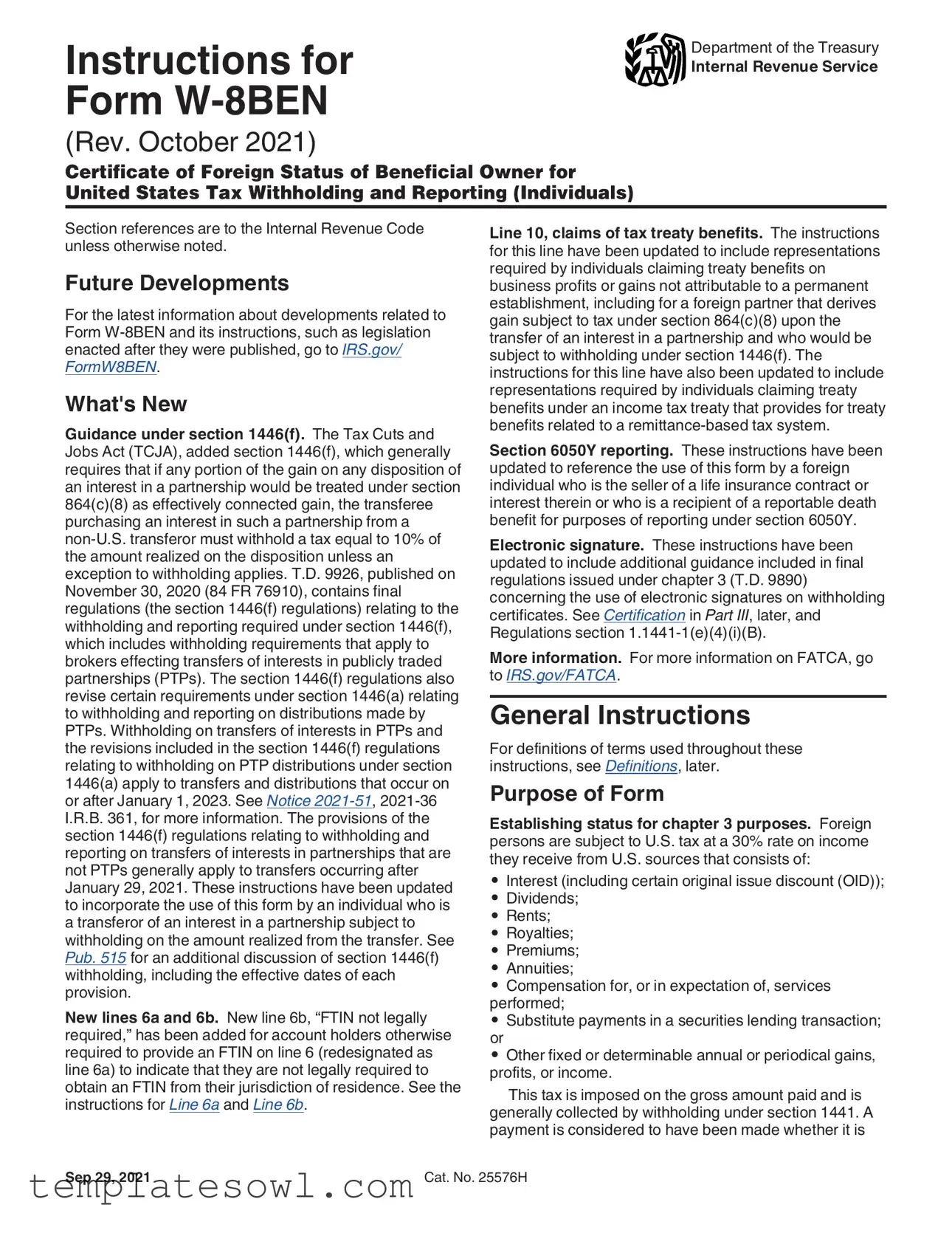
Instructions for
Form
(Rev. October 2021)
Certificate of Foreign Status of Beneficial Owner for United States Tax Withholding and Reporting (Individuals)
Department of the Treasury
Internal Revenue Service
Section references are to the Internal Revenue Code unless otherwise noted.
Future Developments
For the latest information about developments related to Form
What's New
Guidance under section 1446(f). The Tax Cuts and Jobs Act (TCJA), added section 1446(f), which generally requires that if any portion of the gain on any disposition of an interest in a partnership would be treated under section 864(c)(8) as effectively connected gain, the transferee purchasing an interest in such a partnership from a
New lines 6a and 6b. New line 6b, “FTIN not legally required,” has been added for account holders otherwise required to provide an FTIN on line 6 (redesignated as line 6a) to indicate that they are not legally required to obtain an FTIN from their jurisdiction of residence. See the instructions for Line 6a and Line 6b.
Line 10, claims of tax treaty benefits. The instructions for this line have been updated to include representations required by individuals claiming treaty benefits on business profits or gains not attributable to a permanent establishment, including for a foreign partner that derives gain subject to tax under section 864(c)(8) upon the transfer of an interest in a partnership and who would be subject to withholding under section 1446(f). The instructions for this line have also been updated to include representations required by individuals claiming treaty benefits under an income tax treaty that provides for treaty benefits related to a
More information. For more information on FATCA, go to IRS.gov/FATCA.
General Instructions
For definitions of terms used throughout these instructions, see Definitions, later.
Purpose of Form
Establishing status for chapter 3 purposes. Foreign persons are subject to U.S. tax at a 30% rate on income they receive from U.S. sources that consists of:
•Interest (including certain original issue discount (OID));
•Dividends;
•Rents;
•Royalties;
•Premiums;
•Annuities;
•Compensation for, or in expectation of, services performed;
•Substitute payments in a securities lending transaction;
or
•Other fixed or determinable annual or periodical gains, profits, or income.
This tax is imposed on the gross amount paid and is generally collected by withholding under section 1441. A payment is considered to have been made whether it is
Sep 29, 2021 |
Cat. No. 25576H |

made directly to the beneficial owner or to another person, such as an intermediary, agent, or partnership, for the benefit of the beneficial owner.
In addition, section 1446(a) requires a partnership conducting a trade or business in the United States to withhold tax on a foreign partner's distributive share of the partnership's effectively connected taxable income. Also, section 1446(f) generally requires a transferee of a partnership interest (or a broker in the case of a transfer of a PTP interest) to withhold on the amount realized from the transfer by a foreign person when any portion of the gain from the transfer would be treated as effectively connected gain under section 864(c)(8). Generally, a foreign person that is a partner in a partnership that submits a Form
Note. The owner of a disregarded entity (including an individual), rather than the disregarded entity itself, must submit the appropriate Form
If you receive certain types of income, you must provide Form
• Establish that you are not a U.S. person;
• Claim that you are the beneficial owner of the income for which Form
• If applicable, claim a reduced rate of, or exemption from, withholding as a resident of a foreign country with which the United States has an income tax treaty and who is eligible for treaty benefits.
You may also be required to submit Form
• Broker proceeds;
•
• Bank deposit interest;
• Foreign source interest, dividends, rents, or royalties;
• Proceeds from a wager placed by a nonresident alien individual in the games of blackjack, baccarat, craps, roulette, or
• Amounts of United States source gross transportation income, as defined in section 887(b)(1), that are taxable under section 887(a).
A withholding agent or payer of the income may rely on a properly completed Form
Provide Form
Additional information. For additional information and instructions for the withholding agent, see the Instructions for the Requester of Forms
Who Must Provide Form
You must give Form
You should provide Form
You must provide Form
You must provide Form
Do not use Form
• You are a foreign entity documenting your foreign status, documenting your chapter 4 status, or claiming treaty benefits. Instead, use Form
• You are a U.S. citizen (even if you reside outside the United States) or other U.S. person (including a resident alien individual). Instead, use Form
• You are acting as a foreign intermediary (that is, acting not for your own account, but for the account of others as
Instructions for Form |

an agent, nominee, or custodian). Instead, provide Form
• You are a nonresident alien individual who claims exemption from withholding on compensation for independent or dependent personal services performed in the United States. Instead, provide Form 8233 or Form
• You are receiving income that is effectively connected with the conduct of a trade or business in the United States, unless it is allocable to you through a partnership. Instead, provide Form
• You are the trustee of a foreign trust. Instead provide Form
Note. If you own the income or account jointly with one or more other persons, the income or account will be treated by the withholding agent as owned by a foreign person that is a beneficial owner of a payment only if Forms
Expiration of Form
However, under certain conditions a Form
Instructions for Form
Change in circumstances. If a change in circumstances makes any information on the Form
If you use Form
If you become a U.S. citizen or resident alien after you submit Form
You may be a U.S. resident for tax purposes ! depending on the number of days you are
CAUTION physically present in the United States over a
Definitions
Account holder. An account holder is generally the person listed or identified as the holder or owner of a financial account. For example, if a partnership is listed as the holder or owner of a financial account, then the partnership is the account holder, rather than the partners of the partnership (subject to some exceptions). However, an account that is held by a

Amounts subject to withholding. Generally, an amount subject to chapter 3 withholding is an amount from sources within the United States that is fixed or determinable annual or periodical (FDAP) income (including such an amount on a PTP distribution except as indicated otherwise). FDAP income is all income included in gross income, including interest (as well as OID), dividends, rents, royalties, and compensation. FDAP income does not include most gains from the sale of property (including market discount and option premiums), as well as other specific items of income described in Regulations section
Generally, an amount subject to chapter 4 withholding is an amount of U.S. source FDAP income that is also a withholdable payment as defined in Regulations section
For purposes of section 1446(a), the amount subject to withholding is the foreign partner’s share of the partnership’s effectively connected taxable income. For purposes of section 1446(f), the amount subject to withholding is the amount realized on the transfer of a partnership interest.
Beneficial owner. For payments other than those for which a reduced rate of, or exemption from, withholding is claimed under an income tax treaty, the beneficial owner of income is generally the person who is required under U.S. tax principles to include the payment in gross income on a tax return. A person is not a beneficial owner of income, however, to the extent that person is receiving the income as a nominee, agent, or custodian, or to the extent the person is a conduit whose participation in a transaction is disregarded. In the case of amounts paid that do not constitute income, beneficial ownership is determined as if the payment were income.
Foreign partnerships, foreign simple trusts, and foreign grantor trusts are not the beneficial owners of income paid to the partnership or trust. The beneficial owners of income paid to a foreign partnership are generally the partners in the partnership, provided that the partner is not itself a partnership, foreign simple or grantor trust, nominee, or other agent. The beneficial owners of income paid to a foreign simple trust (that is, a foreign trust that is described in section 651(a)) are generally the beneficiaries of the trust, if the beneficiary is not a foreign partnership, foreign simple or grantor trust, nominee, or other agent. The beneficial owners of a foreign grantor trust (that is, a foreign trust to the extent that all or a portion of the income of the trust is treated as owned by the grantor or another person under sections 671 through 679) are the persons treated as the owners of the trust. The beneficial owners of income paid to a foreign complex trust (that is, a foreign trust that is not a foreign simple trust or foreign grantor trust) is the trust itself.
Generally, for purposes of sections 1446(a) and (f), the same beneficial owner rules apply, except that under section 1446(a) and (f) a foreign simple trust is required to
provide a Form
A payment to a U.S. partnership, U.S. trust, or U.S. estate is treated as a payment to a U.S. payee. A U.S. partnership, trust, or estate should provide the withholding agent with a Form
Disregarded entity. A business entity that has a single owner and is not a corporation under Regulations section
Certain entities that are disregarded for U.S. tax purposes may be recognized for purposes of claiming treaty benefits under an applicable tax treaty (see the definition of Hybrid entity,later). A hybrid entity claiming treaty benefits is required to complete Form
Financial account. A financial account includes:
• A depository account maintained by a financial institution;
• A custodial account maintained by a financial institution;
• Equity or debt interests (other than interests regularly traded on an established securities market) in investment entities and certain holding companies, treasury centers, or financial institutions as defined in Regulations section
• Cash value insurance contracts; and
• Annuity contracts.
Instructions for Form |

For purposes of chapter 4, exceptions are provided for accounts such as certain
Financial institution. A financial institution generally means an entity that is a depository institution, custodial institution, investment entity, or an insurance company (or holding company of an insurance company) that issues cash value insurance or annuity contracts.
Foreign financial institution (FFI). An FFI generally means a foreign entity that is a financial institution. Foreign person. A foreign person includes a nonresident alien individual and certain foreign entities that are not U.S. persons (entities that are beneficial owners should complete Form
Hybrid entity. A hybrid entity is any person (other than an individual) that is treated as fiscally transparent for purposes of its status under the Code but is not treated as fiscally transparent by a country with which the United States has an income tax treaty. Hybrid status is relevant for claiming treaty benefits.
Intergovernmental agreement (IGA). An IGA means a Model 1 IGA or a Model 2 IGA. For a list of jurisdictions treated as having in effect a Model 1 or Model 2 IGA, see the list of jurisdictions at www.treasury.gov/resource-
A Model 1 IGA means an agreement between the
United States or the Treasury Department and a foreign government or one or more agencies to implement FATCA through reporting by FFIs to such foreign government or agency, followed by automatic exchange of the reported information with the IRS. An FFI in a Model 1 IGA jurisdiction that performs account reporting to the jurisdiction’s government is referred to as a reporting Model 1 FFI.
A Model 2 IGA means an agreement or arrangement between the United States or the Treasury Department and a foreign government or one or more agencies to implement FATCA through reporting by FFIs directly to the IRS in accordance with the requirements of an FFI agreement, supplemented by the exchange of information between such foreign government or agency and the IRS. An FFI in a Model 2 IGA jurisdiction that has entered into an FFI agreement with respect to a branch is a participating FFI, but may be referred to as a reporting Model 2 FFI.
Nonresident alien individual. Any individual who is not a citizen or resident alien of the United States is a nonresident alien individual. An alien individual meeting either the “green card test” or the “substantial presence test” for the calendar year is a resident alien. Any person not meeting either test is a nonresident alien individual. Additionally, an alien individual who is treated as a nonresident alien pursuant to Regulations section
Instructions for Form
tax liability, or an alien individual who is a bona fide resident of Puerto Rico, Guam, the Commonwealth of the Northern Mariana Islands, the U.S. Virgin Islands, or American Samoa is a nonresident alien individual. See Pub. 519 for more information on resident and nonresident alien status.
Even though a nonresident alien individual ! married to a U.S. citizen or resident alien may
CAUTION choose to be treated as a resident alien for certain purposes (for example, filing a joint income tax return), such individual is still treated as a nonresident alien for chapter 3 withholding tax purposes on all income except wages. For purposes of chapter 4, a nonresident alien individual who holds a joint account with a U.S. person will be considered a holder of a U.S. account for chapter 4 purposes.
Participating FFI. A participating FFI is an FFI that has agreed to comply with the terms of an FFI agreement with respect to all branches of the FFI, other than a branch that is a reporting Model 1 FFI or a U.S. branch. The term “participating FFI” also includes a reporting Model 2 FFI and a qualified intermediary (QI) branch of a U.S. financial institution, unless such branch is a reporting Model 1 FFI. Participating payee. A participating payee means any person that accepts a payment card as payment or accepts payment from a
Payment settlement entity (PSE). A PSE is a merchant acquiring entity or
PTP interest. A PTP interest is an interest in a PTP if the interest is publicly traded on an established securities market or is readily tradable on a secondary market (or the substantial equivalent thereof).
Publicly traded partnership (PTP). A publicly traded partnership is an entity that has the same meaning as in section 7704 and Regulations section
Recalcitrant account holder. A recalcitrant account holder includes an individual who fails to comply with the requests of an FFI for documentation and information for determining the U.S. or foreign status of the individual’s account, including furnishing this Form
Transfer. A transfer is a sale, exchange, or other disposition, and includes a distribution from a partnership to a partner, as well as a transfer treated as a sale or exchange under section 707(a)(2)(B).
Transferee. A transferee is any person, foreign or domestic, that acquires a partnership interest through a transfer and includes a partnership that makes a distribution.

Transferor. A transferor is any person, foreign or domestic, that transfers a partnership interest. In the case of a trust, to the extent all or a portion of the income of the trust is treated as owned by the grantor or another person under sections 671 through 679 (such trust, a grantor trust), the term transferor means the grantor or other person.
U.S. person. A U.S. person is defined in section 7701(a) (30) and includes an individual who is a citizen or resident of the United States. For purposes of chapter 4, a U.S. person is defined in Regulations section
(141).
Withholding agent. Any person, U.S. or foreign, that has control, receipt, custody, disposal, or payment of U.S. source FDAP income subject to chapter 3 or 4 withholding is a withholding agent. The withholding agent may be an individual, corporation, partnership, trust, association, or any other entity, including (but not limited to) any foreign intermediary, foreign partnership, and U.S. branches of certain foreign banks and insurance companies.
For purposes of section 1446(a), the withholding agent is the partnership conducting the trade or business in the United States. For a partnership distribution made by a PTP, the withholding agent for purposes of section 1446(a) may be the PTP, a nominee holding an interest on behalf of a foreign person, or both. See Regulations sections
Specific Instructions
Part I
Line 1. Enter your name. If you are a foreign individual who is the single owner of a disregarded entity that is not claiming treaty benefits as a hybrid entity, with respect to a payment, you should complete this form with your name and information. If the account to which a payment is made or credited is in the name of the disregarded entity, you should inform the withholding agent of this fact. This may be done by including the name and account number of the disregarded entity on line 7 (reference number) of the form. However, if the disregarded entity is claiming treaty benefits as a hybrid entity, it should complete Form
Line 2. Enter your country of citizenship. If you are a dual citizen, enter the country where you are both a citizen and a resident at the time you complete this form. If you are not a resident in any country in which you have citizenship, enter the country where you were most recently a resident. However, if you are a U. S. citizen, you should not complete this form even if you hold citizenship in another jurisdiction. Instead, provide Form
Line 3. Your permanent residence address is the address in the country where you claim to be a resident for purposes of that country’s income tax. If you are completing Form
country, your permanent residence is where you normally reside.
If you reside in a country that does not use street addresses, you may enter a descriptive address on line 3. The address must accurately indicate your permanent residence in the manner used in your jurisdiction.
Line 4. Enter your mailing address only if it is different from the address you show on line 3.
Line 5. If you have a social security number (SSN), enter it here. To apply for an SSN, get Form
If you do not have an SSN and are not eligible to get one, you can get an individual taxpayer identification number (ITIN). To apply for an ITIN, file Form
An ITIN is for tax use only. It does not entitle you ! to social security benefits or change your
CAUTION employment or immigration status under U.S. law.
A partner in a partnership conducting a trade or business in the United States will likely be allocated effectively connected taxable income. In addition, if the partner transfers an interest in such a partnership, the partner may be subject to tax under section 864(c)(8) on the transfer. As in either case the partner is considered engaged in a U.S. trade or business because it is a partner in a partnership engaged in a U.S. trade or business, the partner is required to file a U.S. federal income tax return and must have a U.S. taxpayer identification number (ITIN), which the partner is required to provide on this form.
You must also provide an SSN or TIN if you are:
• Claiming an exemption from withholding under section 871(f) for certain annuities received under qualified plans, or
• Submitting the form to a partnership that conducts a trade or business in the United States.
If you are claiming treaty benefits, you are generally required to provide an ITIN if you do not provide a tax identifying number issued to you by your jurisdiction of tax residence on line 6. However, an ITIN is not required to claim treaty benefits relating to:
• Dividends and interest from stocks and debt obligations that are actively traded;
• Dividends from any redeemable security issued by an investment company registered under the Investment Company Act of 1940 (mutual fund);
• Dividends, interest, or royalties from units of beneficial interest in a unit investment trust that are (or were upon issuance) publicly offered and are registered with the SEC under the Securities Act of 1933; and
• Income related to loans of any of the above securities. Line 6a. If you are providing this Form
Instructions for Form |

financial account (as defined in Regulations section
• You are a resident of a U.S. territory, or
• Your jurisdiction of residence is identified on the IRS’s List of Jurisdictions That Do Not Issue Foreign TINs at
In addition, you may provide the FTIN issued to you by your jurisdiction of tax residence on line 6a for purposes of claiming treaty benefits (rather than providing a U.S. TIN on line 5, if required).
Line 6b. You may check the box in this line 6b if you are an account holder as described for purposes of line 6a and you are not legally required to obtain an FTIN from your jurisdiction of residence (including if the jurisdiction does not issue TINs). By checking this box, you will be treated as having provided an explanation for not providing an FTIN on line 6a. If you wish to provide a further (or other) explanation why you are not required to provide an FTIN on line 6a, you may do so in the margins of this form or on a separate statement attached to this form.
Line 7. This line may be used by the filer of Form
Line 8. If you are providing this Form
Part II
Line 9. If you are claiming treaty benefits as a resident of a foreign country with which the United States has an income tax treaty for payments subject to withholding under chapter 3 or under section 1446(a) or (f), identify the country where you claim to be a resident for income tax treaty purposes. For treaty purposes, a person is a resident of a treaty country if the person is a resident of
Instructions for Form
that country under the terms of the treaty. A list of U.S. tax treaties is available at IRS.gov/Individuals/International-
If you are related to the withholding agent within ! the meaning of section 267(b) or 707(b) and the
CAUTION aggregate amount subject to withholding received during the calendar year exceeds $500,000, then you are generally required to file Form 8833,
Line 10. Line 10 must be used only if you are claiming treaty benefits that require that you meet conditions not covered by the representations you make on line 9 and Part III. This line is generally not applicable to treaty benefits under an interest or dividends (other than dividends subject to a preferential rate based on ownership) article of a treaty. Examples of when you must complete line 10 include:
• Persons claiming treaty benefits on royalties must complete this line if the treaty contains different withholding rates for different types of royalties,
• Foreign students and researchers claiming treaty benefits must complete this line. See Scholarship and fellowship grants, later, for more information,
• Persons claiming treaty benefits on business profits or gains that are not attributable to a permanent establishment must complete this line. See Profits or gains not attributable to a permanent establishment, later, for more information.
• Persons claiming treaty benefits pursuant to a remittance provision under a treaty must complete this line. See Remittance claims, later, for more information
Nonresident alien who becomes a resident alien. Generally, only a nonresident alien individual can use the terms of a tax treaty to reduce or eliminate U.S. tax on certain types of income. However, most tax treaties contain a provision known as a “saving clause” which preserves or “saves” the right of each country to tax its own residents as if no tax treaty existed. Exceptions specified in the saving clause may permit an exemption from tax to continue for certain types of income even after the recipient has otherwise become a U.S. resident alien for tax purposes. The individual must use Form
Profits or gains not attributable to a permanent es- tablishment. Persons claiming treaty benefits on business profits not attributable to a permanent establishment or on gains arising from the alienation of property (other than real property) that does not form all or part of a permanent establishment (including gains that do not arise from the alienation of a permanent establishment) must complete line 10. Complete line 10 by stating that you derive business profits or gains (other than from real property) not attributable to a permanent establishment. You must also include the relevant treaty article. For example, a foreign partner that derives gains subject to tax under section 864(c)(8) upon the transfer of

an interest in a partnership that conducts a trade or business within the United States may claim treaty benefits on this form with respect to the withholding required under section 1446(f) by stating that the gains are not attributable to a permanent establishment and by including the relevant gains article of the treaty. Additionally, for a claim that gain or income with respect to a PTP interest is not attributable to a permanent establishment in the United States, you must identify the name of each PTP to which the claim relates. See, however, Regulations section
If you are a nonresident alien individual who TIP received noncompensatory scholarship or
fellowship income and personal services income (including compensatory scholarship or fellowship income) from the same withholding agent, you may use Form 8233 to claim a tax treaty withholding exemption for part or all of both types of income.
Completing lines 3 and 9. Most tax treaties that contain an article exempting scholarship or fellowship grant income from taxation require that the recipient be a resident of the other treaty country at the time of, or immediately prior to, entry into the United States. Thus, a student or researcher may claim the exemption even if he or she no longer has a permanent address in the other
treaty country after entry into the United States. If this is the case, you can provide a U.S. address on line 3 and still be eligible for the exemption if all other conditions required by the tax treaty are met. You must also identify on line 9 the tax treaty country of which you were a resident at the time of, or immediately prior to, your entry into the United States.
Nonresident alien student or researcher who becomes a resident alien. You must use Form
Example. Article 20 of the United
Part III
Certification
Form
A withholding agent may allow you to provide this form with an electronic signature. The electronic signature must indicate that the form was electronically signed by a person authorized to do so (for example, with a time and date stamp and statement that the form has been electronically signed). Simply typing your name into the signature line is not an electronic signature. A withholding agent may also rely on an electronically signed withholding certificate if you provide any additional information or documentation requested by the withholding agent to support that the form was signed by you or other person authorized to do so. See Regulations section
Instructions for Form |

If any information on Form
CAUTION days unless you are no longer an account holder of the requester that is an FFI and you will not receive a future payment with respect to the account.
Broker transactions or barter exchanges. Income from transactions with a broker or a barter exchange is subject to reporting rules and backup withholding unless Form
You are an exempt foreign person for a calendar year in which:
• You are a nonresident alien individual or a foreign corporation, partnership, estate, or trust;
• You are an individual who has not been, and does not plan to be, present in the United States for a total of 183 days or more during the calendar year; and
• You are neither engaged, nor plan to be engaged during the year, in a U.S. trade or business that has effectively connected gains from transactions with a broker or barter exchange.
Paperwork Reduction Act Notice. We ask for the information on this form to carry out the Internal Revenue laws of the United States. You are required to provide the information. We need it to ensure that you are complying with these laws and to allow us to figure and collect the right amount of tax.
You are not required to provide the information
requested on a form that is subject to the Paperwork Reduction Act unless the form displays a valid OMB control number. Books or records relating to a form or its instructions must be retained as long as their contents may become material in the administration of any Internal Revenue law. Generally, tax returns and return information are confidential, as required by section 6103.
The time needed to complete and file this form will vary depending on individual circumstances. The estimated burden for business taxpayers filing this form is approved under OMB control number
If you have comments concerning the accuracy of these time estimates or suggestions for making this form simpler, we would be happy to hear from you. You can send us comments from IRS.gov/FormComments.
You can write to Internal Revenue Service, Tax Forms and Publications, 1111 Constitution Ave. NW,
Instructions for Form |
Form Characteristics
| Fact Name | Fact Details |
|---|---|
| Form Purpose | Form W-8BEN is used to certify foreign status for tax withholding purposes. |
| Applicable Law | This form complies with sections of the Internal Revenue Code, notably sections 1441, 1442, and 1446. |
| Tax Rate for Foreign Persons | Foreign individuals are subject to a 30% tax rate on U.S.-sourced income unless reduced by a tax treaty. |
| Changes in Regulations | New regulations were introduced under section 1446(f) in 2020, affecting withholding on transfers of partnership interests. |
| Validity Period | A completed Form W-8BEN generally remains valid until the last day of the third calendar year after it was signed. |
| Submission Guidelines | The form must be given to the withholding agent, not submitted to the IRS. |
| Electronic Signatures | Final regulations permit the use of electronic signatures on Form W-8BEN. |
| Impact of Change in Circumstances | Any change in circumstances must be reported within 30 days, requiring a new form submission. |
| New Line Additions | Lines 6a and 6b were added to address the requirement for a Foreign Tax Identification Number (FTIN). |
| Who Must Use | Nonresident aliens who are beneficial owners of income subject to withholding must complete this form. |
Guidelines on Utilizing W8Ben Instructions
Once the W-8BEN Form is completed, it should be submitted to the withholding agent or payer who requested it. This process does not involve sending the form to the IRS. Completing the form accurately ensures that the relevant withholding tax regulations are met according to U.S. tax laws.
- Obtain the W-8BEN Form, which is available online via the IRS website or from the withholding agent.
- Fill out your name in Part I, line 1. Include your country of citizenship on line 2.
- Provide your permanent address in line 3. Make sure this address is outside of the United States.
- If applicable, fill in your mailing address in line 4. This can be the same as your permanent address.
- On line 5, enter your Foreign Tax Identification Number (FTIN) if you have one. If not, refer to line 6a or 6b for specifics on your situation.
- Sign and date the form in Part III, certifying that the information is correct and that you are not a U.S. person.
- Review all entries for accuracy. Ensure that all parts of the form are filled out completely and correctly.
- Submit the completed form to the withholding agent or payer who requested it before any income payments are made. Do not send it to the IRS.
What You Should Know About This Form
What is the purpose of Form W-8BEN?
The Form W-8BEN is used by foreign individuals to establish their status as non-U.S. persons for the purposes of U.S. tax withholding and reporting. This form helps the IRS identify foreign individuals who may be eligible for a reduced withholding tax rate or exemption under an applicable tax treaty. It must be provided to withholding agents or payers before any income is paid to ensure proper tax treatment.
Who should fill out the W-8BEN form?
This form should be completed by nonresident alien individuals who are beneficial owners of income that is subject to U.S. tax withholding. If a foreign individual is a partner in a partnership, they also need to submit this form to document their status. It’s important to note that individuals should not fill this form out if they are U.S. citizens or other U.S. persons; in those cases, Form W-9 should be used.
What information is required on the W-8BEN form?
The form requires basic personal information such as the individual's name, country of citizenship, and address. In cases where treaty benefits are claimed, additional details may be necessary, including the specific treaty provisions being claimed. It is also important to provide a Foreign Tax Identification Number (FTIN) where applicable.
How long is the W-8BEN form valid?
Generally, the W-8BEN form remains valid for three years after the date it is signed. However, if there is a change in circumstances that makes the information on the form incorrect, a new form must be submitted within 30 days. Examples of changes include moving to the U.S. or becoming a U.S. citizen.
What happens if I do not provide the W-8BEN form?
If the Form W-8BEN is not provided to the withholding agent, the income paid may be subject to a default withholding tax rate of 30%. This could apply to various types of U.S. sourced income, including interest, dividends, and royalties. Providing the form timely can help avoid unnecessary tax withholding.
Can the W-8BEN be submitted electronically?
Yes, the W-8BEN can be submitted electronically, provided that it complies with the guidelines for electronic signatures as specified by the IRS. It is recommended to check for any updates regarding electronic submissions to ensure compliance.
What should I do if my circumstances change after submitting the W-8BEN?
If any information on your W-8BEN becomes incorrect due to a change in your situation—like moving to the U.S. or changing your residency—it is essential to notify the withholding agent or payer within 30 days and file a new W-8BEN or a different appropriate form.
How do I submit the W-8BEN form?
The W-8BEN form should not be sent to the IRS. Instead, it must be given directly to the withholding agent or payer requesting it. Generally, this will be the person or entity making payments to you. It's best to submit the form before any payment is made to avoid complications with withholding.
Are there different forms for entities versus individuals?
Yes, there is a separate form, the W-8BEN-E, for foreign entities. This form is specifically designed for foreign corporations and other organizations that need to establish their foreign status and claim any treaty benefits. Individuals must use the W-8BEN form exclusively.
Common mistakes
Filling out the W-8BEN form can be straightforward, but many individuals make common mistakes that can cause issues with U.S. tax withholding. One prevalent error is failing to provide accurate personal information. It is crucial to enter your full name, country of citizenship, and permanent address correctly. Omitting any of this information can lead to confusion and potential delays in processing your form.
Another frequent mistake is neglecting to claim treaty benefits properly. If you are eligible for tax treaty benefits, you must clearly indicate this on the form. Individuals often fail to complete the necessary lines to make their claims explicit. The absence of this information could result in higher withholding rates, which you may later seek to recover.
Incorrectly completing Line 6 is another issue. This line addresses the Foreign Tax Identification Number (FTIN). Individuals often either leave it blank or provide the wrong number. If your jurisdiction does not require an FTIN, ensure you mark Line 6b appropriately. Otherwise, failing to include the correct FTIN can slow down the processing of your payment.
Moreover, some individuals do not renew the form when required. The W-8BEN form is valid only for a specific period; it typically remains effective for three years. When that period expires, a new form must be submitted. If not done timely, the withholding agent might apply a higher withholding rate.
Another mistake involves submitting the form to the IRS instead of the withholding agent. Many people misunderstand that W-8BEN forms should not be sent to the IRS directly. It is essential to give the completed form to the person or entity that requested it, ensuring compliance and preventing unnecessary withholding.
Lastly, ignoring changes in circumstances can lead to complications. If your situation changes—such as relocating to the United States—you must notify the withholding agent and potentially submit a new W-8BEN. A failure to report such changes can result in outdated information on file, which may affect your tax status and withholding rates.
Documents used along the form
When completing the W-8BEN form, other documents may often accompany it. These forms help streamline the withholding and reporting processes associated with U.S. tax obligations for foreign entities and individuals. Understanding these additional documents can provide clarity on compliance and necessary steps.
- W-8BEN-E: This form is used by foreign entities, such as corporations or partnerships, to certify their foreign status for U.S. tax purposes. Unlike the W-8BEN, which is for individuals, the W-8BEN-E includes specific sections for various types of entities claiming treaty benefits.
- W-8ECI: Foreign individuals or entities use this form to report income that is effectively connected with the conduct of a trade or business in the U.S. This form is essential for establishing the income that will be taxed as effectively connected income instead of being subject to the withholding tax.
- W-8IMY: This form applies to foreign intermediaries and flow-through entities that receive payments on behalf of others. It certifies the intermediary's status and provides information about other parties involved in the transaction.
- Form 8233: Nonresident aliens use this form to claim exemption from withholding on compensation for independent services performed in the U.S. It is specifically designed for individuals who qualify for tax treaty benefits related to personal services.
- Form W-9: U.S. persons, including residents and entities, may need to submit this form to certify their taxpayer identification number and claim exemption from backup withholding. It is essential to differentiate between U.S. and foreign persons for tax reporting purposes.
- Form 6050Y: This form is used to report certain information about life insurance contracts and reportable death benefits. It assists in establishing the foreign status of individuals involved in these transactions for compliance purposes.
Gathering and submitting these forms, alongside the W-8BEN, helps ensure that foreign individuals and entities accurately report their status and income for tax purposes. Understanding these related documents can aid in compliance with U.S. tax laws.
Similar forms
The W-8BEN Instructions form is similar to a number of other important documents used for tax purposes by foreign individuals and entities. Here are six documents that share similarities with the W-8BEN Instructions:
- Form W-8BEN-E: This form is used by foreign entities rather than individuals to document their foreign status. Like the W-8BEN, it establishes the entity’s claim for reduced withholding rates or exemptions under tax treaties.
- Form W-9: U.S. persons use this form to provide their taxpayer identification information to withholding agents. While the W-8BEN certifies foreign status, the W-9 confirms a U.S. person's status for tax purposes.
- Form W-8ECI: This form is applicable when a foreign individual is claiming that the income they receive is effectively connected with a trade or business in the U.S. Similar to the W-8BEN, it helps manage the proper withholding of taxes.
- Form W-4: This form is used by employees in the U.S. to indicate their tax situation to their employer. Although W-4 pertains to U.S. residency, both forms serve to ensure proper withholding of taxes.
- Form 8233: Nonresident aliens who claim exemption from withholding on compensation for personal services use this form. Like the W-8BEN, it addresses specific situations that require tax treaty considerations.
- Form W-8IMY: This document is meant for foreign intermediaries acting on behalf of others. It represents a connection to the concept of beneficial ownership, similar to what is addressed in the W-8BEN.
Dos and Don'ts
When filling out the W-8BEN form, following best practices can help ensure accuracy and compliance. Below is a list of ten things to consider:
- Do review the instructions thoroughly before beginning the form.
- Do ensure that you accurately identify your status as a foreign individual.
- Do provide correct personal information, including your name and foreign address.
- Do claim any applicable tax treaty benefits, if eligible, on Line 10.
- Do submit the form to the withholding agent or payer before any payment is made.
- Don’t use the W-8BEN form if your situation requires Form W-8BEN-E instead.
- Don’t provide the form directly to the IRS; it should go to the requester only.
- Don’t forget to update the form if a change in circumstances occurs, like moving to the U.S.
- Don’t use outdated versions of the form; always ensure you have the latest version.
- Don't omit line items; incomplete forms may lead to unnecessary withholding.
Taking these steps seriously can streamline the process and minimize issues with U.S. tax withholding requirements.
Misconceptions
1. The W-8BEN form is only for non-U.S. citizens. Many people think that only non-U.S. citizens need to complete the W-8BEN. However, it applies to any foreign person, including nonresident aliens, who receive income from U.S. sources.
2. Submitting the W-8BEN to the IRS is mandatory. It is a common misconception that the W-8BEN must be sent to the IRS. In fact, individuals must provide the form directly to the withholding agent or payer requesting it.
3. All foreign individuals need an FTIN. Some believe that all foreign individuals must obtain a Foreign Tax Identification Number (FTIN). The W-8BEN allows for the option to indicate "FTIN not legally required" if the individual is not obligated to have one in their jurisdiction.
4. The W-8BEN is valid indefinitely. Many assume that once completed, the W-8BEN remains valid forever. In reality, it generally stays effective for three years after signing, unless there is a change in circumstances.
5. You can submit one form for multiple types of income. Individuals often think they can submit a single W-8BEN for various income types. However, a separate form may be required for different types of income to satisfy withholding agents.
6. All foreign entities can use the W-8BEN. This form is specifically for individuals, not entities. Foreign entities must complete the W-8BEN-E instead.
7. W-8BEN guarantees exemption from U.S. withholding tax. Misunderstandings exist regarding the idea that submitting this form automatically means no withholding tax. The form helps in applying for reduced withholding rates under applicable tax treaties, but does not guarantee full exemption.
8. You do not need to notify withholding agents of address changes. Some believe that moving addresses does not require any updates to the W-8BEN. However, a change of address to a U.S. location is indeed a change in circumstances that necessitates informing the withholding agent.
9. W-8BEN form completion is optional for receiving U.S. income. It is a misconception that providing the W-8BEN is optional. Failing to submit it when required can lead to a higher withholding rate of 30% on U.S. source income.
10. All U.S. source income is subject to the same withholding rate. Many are unaware that different types of U.S. source income may have varying rates of withholding. The W-8BEN is crucial for determining the applicable rate based on the specific situation.
Key takeaways
The W-8BEN form is a crucial document for foreign individuals who wish to establish their non-U.S. status for taxation purposes. Here are key takeaways when filling out and using the form:
- Purpose of the Form: The W-8BEN certifies that you are a foreign person, and establishes your eligibility for benefits such as reduced withholding rates under applicable tax treaties.
- Submission Guidelines: Always submit the W-8BEN to the withholding agent or payer, not the IRS. Provide the form before any income is paid out to avoid automatic withholding at a higher rate.
- Checking for Updates: Tax regulations change frequently, so check IRS.gov regularly for the latest information regarding Form W-8BEN.
- Line Clarifications: Understand each line's requirements. For instance, line 6 now allows you to indicate if a Foreign Tax Identification Number (FTIN) is not required in your home jurisdiction.
- Validity Period: The form is generally valid for three years unless a change in your status occurs, making the information incorrect.
- Impact of Changes: If you change your residency status or move to the United States, report these changes to your withholding agent within 30 days to ensure compliance.
- Claiming Treaty Benefits: When claiming tax treaty benefits, be prepared to provide specific representations about the type of income you are receiving and its relationship to a permanent establishment.
- Disregarded Entities: If owning a disregarded entity, the owner must provide the W-8BEN, not the entity itself, to document foreign status.
- Exponential Benefits: Using W-8BEN can help facilitate lower tax withholding on certain types of U.S. sourced income, making it financially advantageous for foreign entities and individuals.
- Need for Additional Forms: If your income becomes effectively connected with a U.S. trade or business, you will need to use Form W-8ECI instead.
Understanding these key aspects will ensure effective use of the W-8BEN form, allowing for appropriate tax treatment according to U.S. law.
Browse Other Templates
Scaled Score to Standard Score - As scores decrease below 100, the category transitions from "Average" to lower classifications.
Child Support Income Declaration,Affidavit of Income for Child Support,Income Verification Affidavit,Child Support Financial Statement,Affidavit of Monthly Earnings,Child Support Income Disclosure,Income Statement for Support Obligations,Affidavit of - Affiants are responsible for declaring any changes in financial circumstances as they arise.